From Mythology to Art & Technology for the Regeneration of our Planet
ioanna
6th ALPHA MISSION – ΔELOS Global Gathering The Pulse of Life From Delos to Mykonos, diverse voices explored the interconnectedness of personal and planetary wellbeing
latest update: 22/05/2026
What insights can ancient healing wisdom offer us today? Can humanity flourish beyond Earth? Is it possible to restore balance between our lives and the health of our planet?
The visionary initiative ALPHA MISSION – ΔELOS returned for its sixth Global Gathering in the heart of the Cyclades, Greece, on 16 and 17 May 2026. Centred around the theme “The Pulse of Life: Re-connecting Personal to Planetary Health”, academics, scientists and artists explored the living connections between human wellbeing and the health of our planet through two days of meaningful dialogue, insightful discussions, exchange of ideas and profound human connection.
The 6th ALPHA MISSION – ΔELOS Global Gathering in Mykonos
Further supporting the pioneering initiative’s goal of fostering public awareness and civic engagement around the major challenges facing life on Earth, this year’s distinguished speakers also met with the local community of Mykonos. On Saturday, 16 May 2026, local residents warmly embraced the open event held at Cine Manto, featuring keynote speakers: Vassilis Lamprinoudakis (Professor Emeritus of Archaeology, National and Kapodistrian University of Athens), Dr Stamatios (Tom) Krimigis (Emeritus Head, Space Exploration Sector, Johns Hopkins Applied Physics Laboratory; former President, Academy of Athens), and Dimosthenis Sarigiannis (Director and President of the Board, National Hellenic Research Foundation; Professor of Environmental Engineering, Aristotle University of Thessaloniki).
The speakers were introduced by Demetris Athanasoulis (Director, Ephorate of Antiquities of Cyclades), Nikos Sergis (CEO, Hellenic Space Centre) and Vangelis Karkaletsis (President, NCSR “Demokritos”). The evening opened with remarks by Alexandra Mitsotaki (President & Co-founder, World Human Forum), Dimitris Papastergiou (Minister of Digital Governance, Hellenic Republic), and Christos Veronis (Mayor of Mykonos), and concluded with a screening of the award-winning film/concert The [Uncertain] Four Seasons.
“Re-connecting Personal to Planetary Health” on Delos
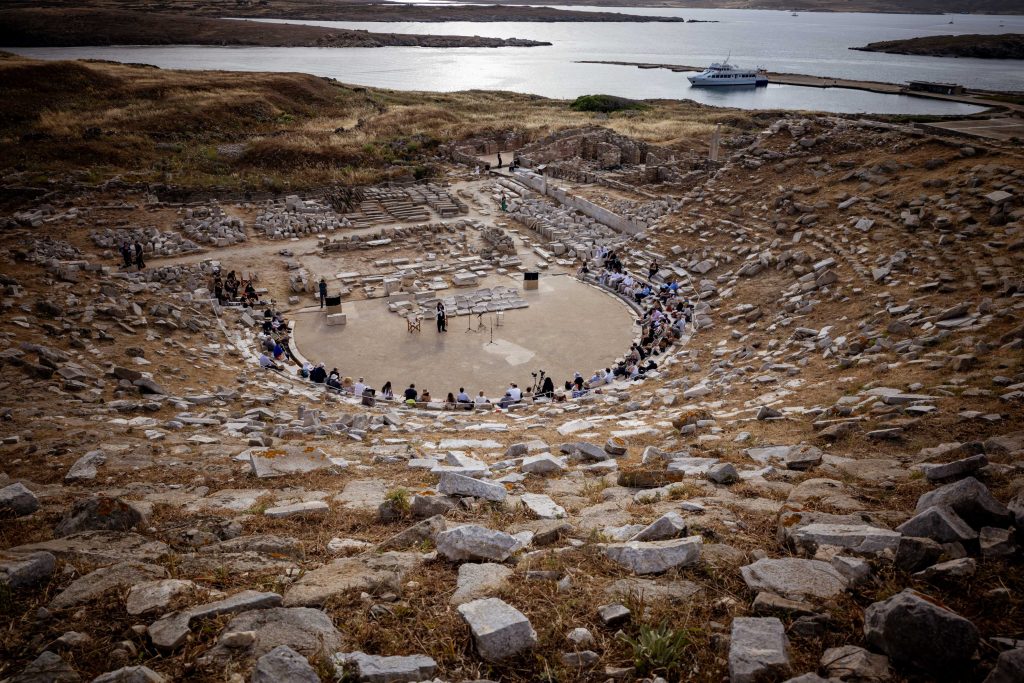
On Sunday, 17 May 2026, the gathering continued at the ancient theatre of Delos with the participation of leading scientists, researchers and artists. This year’s programme featured: Daniel A. Barber (Professor of Architecture and Chair of the Working Group on Architecture History and Decarbonisation, Techninal University of Eindhoven), Alexander Choukér (Academic Director, Senior Physician, Head of Research Laboratory I “Translational Stress and Immunity Research”, University Hospital Munich), Adrianos Golemis (Astronaut in Training; Collaborator, Hellenic Space Center; Lead Flight Surgeon, MEDES – European Space Agency), Niki Evelpidou (Professor, Department of Geology and Geoenvironment, National and Kapodistrian University of Athens), Athéna Coustenis (Director of Research, National Centre for Scientific Research / CNRS, France), Yadvinder Malhi (Professor of Ecosystem Science, University of Oxford), Jacob Moe (Founder & Director, Archipelago Network), Dr Alexis Paterson (Senior Music Programme Producer, Schwarzman Centre, University of Oxford), and Jochen Sandig (Co-founder & Vice President, World Human Forum).
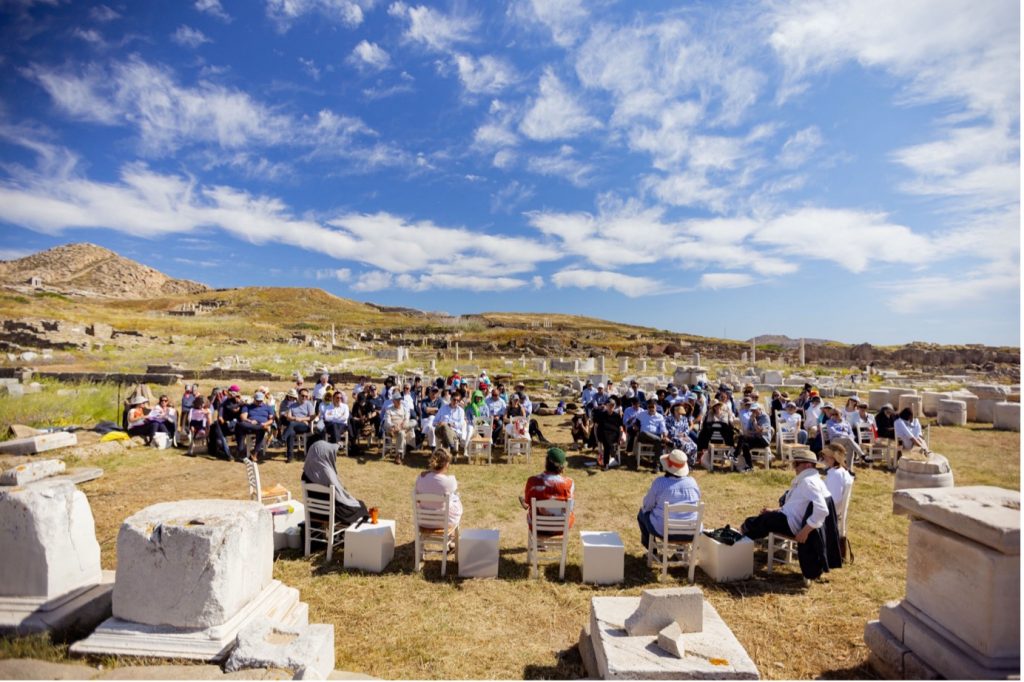
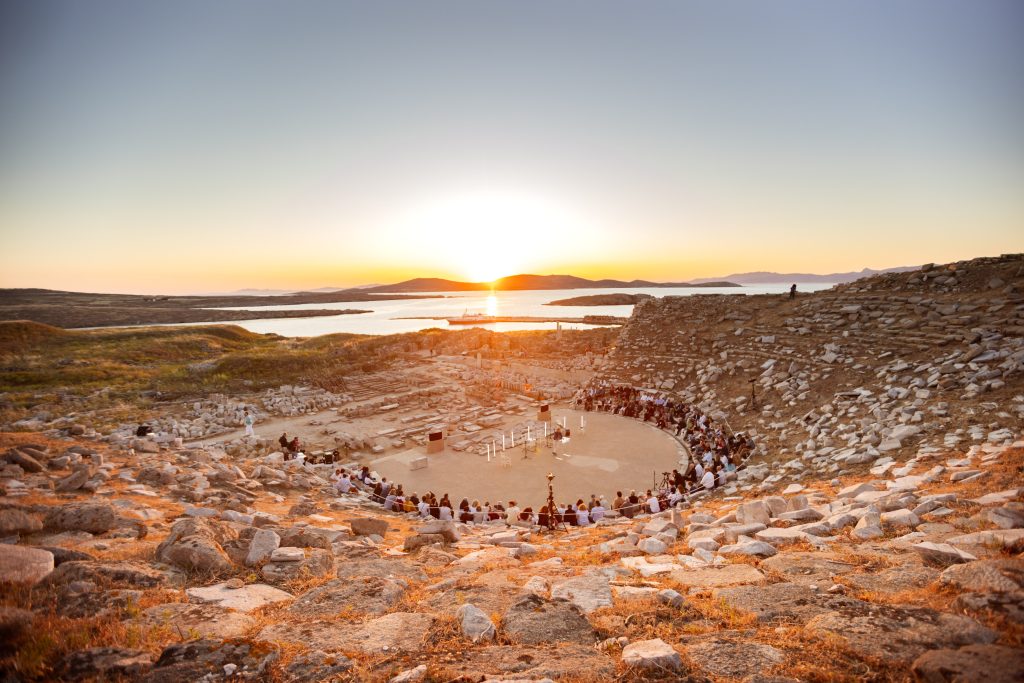
The day began with an onboard presentation and guided talk by Professor Vassilis Lamprinoudakis on the Asklepieion of Delos and the ancient Greeks’ holistic approach to healing. As the afternoon light softened across the Aegean, participants shared a collective message distilled through an interactive artistic workshop. They were also invited to join the concert The 5th Season, featuring Sokratis Sinopoulos (lyra) and Diana Tishchenko (violin), which brought the gathering to a close.
Let us hold on to their reflections: “The Earth is not silent. She speaks — can you hear her? / A tiny lifeboat, hanging quietly in the universe, blue and breathing in the dark / Planet Earth is blue and there’s something we can do / If we could carry our values into this fragile spaceship, let them be: love, respect, hope, compassion, roots, and time / Because in everything, we are nothing, but in that nothing, we are everything.”
About ALPHA MISSION – ΔELOS
ALPHA MISSION – ΔELOS aims to raise awareness around the climate crisis. At this critical moment for our planet, Delos — one of antiquity’s most important cosmopolitan centres, where numerous languages were spoken and diverse faiths coexisted — is already being affected by rising sea levels.
The initiative invites us to remember the roots that gave us wings — science and technology, but also ancestral intelligence, the humanities, the arts and spirituality — and to imagine a civilisation that honours and protects life in all its forms.
ALPHA MISSION – ΔELOS is an initiative of the World Human Forum. It is organised in collaboration with the Ephorate of Antiquities of Cyclades and in partnership with the National Centre for Scientific Research “Demokritos”, the Hellenic Space Center, and Europa Nostra.
The 6th ALPHA MISSION – ΔELOS Global Gathering was held with the support of:
Strategic Partners: HELMEPA – Hellenic Marine Environment Protection Association, IEEE SA Sponsors: Alpha Bank, Qualco Foundation Donor: COSMOTE TELEKOM Official Airline Partner: Aegean Airlines Travel Partners: Blue Star Ferries, Autohellas Hertz Supporting Partners: Rtdeco Event Services, View Master Events, Delos Tours Special Partner: ELTA / Hellenic Post Special thanks to the Municipality of Mykonos and Manto Cinema
Recorded sessions and activities from the 6th ALPHA MISSION – ΔELOS Global Gathering will soon be available on the World Human Forum YouTube channel.
Re-connecting Personal to Planetary Health: Join us in Mykonos Exploring the pulse that connects all forms of life, at an open event in Mykonos
latest update: 15/05/2026
Five years ago, a new mission was launched on Delos. The visionary initiative ALPHA MISSION – ΔELOS brings together leading figures from diverse fields to the heart of the Cyclades each May. Its purpose is to foster dialogue on the future of humanity, while raising awareness and encouraging action on the major challenges facing life on our planet – the “pale blue dot”, our only known home.
On Saturday 16 May 2026 at 19:00, at Manto Cinema in Chora Mykonos, academics, scientists and artists will meet with the local community to explore the pulse that connects all forms of life, and to examine the living connections between human wellbeing and the health of our planet.
The event “The Pulse of Life: Re-connecting Personal and Planetary Health” will feature, among others, the following speakers:
Stamatios (Tom) Krimigis, Emeritus Head, Space Exploration Sector, Johns Hopkins University Applied Physics Laboratory; former President, Academy of Athens
Vassilis Lamprinoudakis, Emeritus Professor of Archaeology, National and Kapodistrian University of Athens
Dimosthenis Sarigiannis, Director and President of the Board, National Hellenic Research Foundation; Professor of Environmental Engineering, Aristotle University of Thessaloniki
The evening will conclude with a screening of the award-winning film/concert “The [Uncertain] Four Seasons – Delos”.
Programme
Introduction
Alexandra Mitsotaki, President & Co-founder, World Human Forum
Dimitris Papastergiou, Minister of Digital Governance
The Ancient Wisdom of Healing
Demetris Athanasoulis, Director, Ephorate of Antiquities of the Cyclades
Vassilis Lamprinoudakis, Professor Emeritus of Archaeology, NKUA
Planet Earth in Context: Solar System and the Galaxy
Dr Stamatios (Tom) Krimigis, Emeritus Head, Space Exploration Sector, Johns Hopkins University Applied Physics Laboratory; former President, Academy of Athens
Nick Sergis, CEO, Hellenic Space Center
One Health: Personal and Planetary
Dimosthenis Sarigiannis, Director and President of the Board, National Hellenic Research Foundation; Professor of Environmental Engineering, Aristotle University of Thessaloniki
The Arts as a Connective Force | film introduction
Diana Tishchenko, Violonist
Sokratis Sinopoulos, Lyra soloist
The [Uncertain] Four Seasons – Delos | film screening (duration: 63΄)
About ALPHA MISSION – ΔELOS
The aim of ALPHA MISSION – ΔELOS is to raise awareness of the climate crisis. At this critical moment for our planet, Delos – one of the most important cosmopolitan centres of antiquity and a historic meeting point of cultures, languages and religious traditions – is already experiencing the impacts of rising sea levels.
The initiative invites us to reflect on the roots that have given us wings: science and technology, ancestral intelligence, the humanities, the arts and spirituality – and to imagine a civilisation that respects and protects life in all its forms.
Artemis: from Delos to the Moon Artemis II mission and the enduring message of ALPHA MISSION – ΔELOS on the need to protect life on planet Earth
latest update: 12/05/2026
On 1 April 2026, millions of people from every corner of the planet watched live the historic launch of the Artemis II mission. For the first time in more than half a century—since Apollo 17 in 1972—a crewed space mission once again approached the Moon, even beholding its far side. During its ten-day journey, the Orion spacecraft, crewed by Reid Wiseman, Victor Glover, Christina Koch and Jeremy Hansen, carried around the natural satellite of the Earth the first woman, the first Black astronaut, and the first non-American astronaut. And while humanity returns to the Moon’s neighbourhood, for the past five years ALPHA MISSION – ΔELOS has been raising awareness about the need to protect life on our planet.
Apollo and Artemis: these historic missions were named after the gods of light and the Moon in ancient Greek mythology. An inspired and fitting connection, also highlighted by Dr Nicola Fox, NASA Head of Science, during her remarks in May 2024 at the 4th ALPHA MISSION – ΔELOS Gathering.
For it is on the sacred island of Delos—where, according to myth, the twin children of Leto and Zeus were born—that a new mission began at the same time as the Artemis mission. The visionary initiative ALPHA MISSION – ΔELOS brings leading figures from diverse fields to the heart of the Cyclades every May to discuss the future of humanity and life on the “pale blue dot”, the only home we have ever known: Earth. The initiative has been supported since its early stages by Stamatios Krimigis, Emeritus Head of the Space Exploration Sector at the Johns Hopkins Applied Physics Laboratory and former President of the Academy of Athens.
The aim of ALPHA MISSION – ΔELOS is to raise awareness of the climate crisis. At this critical moment for our planet, Delos—the first cosmopolitan centre of the Mediterranean, where numerous languages were spoken and diverse faiths coexisted—is already being affected by rising sea levels. Today, it invites us to pause for a moment: to remember the roots that gave us wings—science and technology, but also ancestral intelligence, the humanities, the arts, and spirituality—and to imagine a civilisation that honours life in all its forms.
It is worth noting that, drawing on ALPHA MISSION – ΔELOS, the Artemis mission and its connection to Greek culture, the International Sustainability Education Network “From Mythology to Space – Myth2space” has been created. This innovative endeavour brings together pupils from urban centres and regional areas, fostering skills such as collaboration, critical thinking, computational thinking and a holistic approach to concepts. The network now includes 15,000 pupils from 713 classes in primary and secondary education.
You can watch the Delos international gatherings on the World Human Forum’s YouTube channel:
ALPHA MISSION – ΔELOS 2025: Human Settlements: From the Earth to the Moon and Beyond Delos, May 2025
latest update: 10/06/2025
On 26–27 May 2025, beneath the radiant Aegean sun, on the sacred island of Delos—birthplace of Apollo and Artemis, once one of the first cosmopolitan centres of the Mediterranean and now an open-air museum—the 5th ALPHA MISSION – ΔELOS Global Gathering took place. Entitled “Human Settlements: From the Earth to the Moon and Beyond”, this year’s gathering invited a global constellation of thinkers, scientists, and artists to re-imagine how we inhabit the world—and worlds beyond.
Drawing inspiration from Delos’s example as a resilient, ecologically balanced settlement that once sustained almost 30,000 people in balance with its finite resources, the gathering turned to the past to inform visions of the future. In the spirit of Apollo, long associated with light, but also worshipped as Ktistes and Archegetes—divine founder of cities—, the discussions developed around how to build wisely, responsibly, and in harmony with the worlds we inhabit.
ALPHA MISSION – ΔELOS is a World Human Forum initiative in collaboration with the Ephorate of Antiquities of the Cyclades and in partnership with the National Centre of Scientific Research “Demokritos”, the Hellenic Space Center and Europa Nostra.
Among this year’s participants —scientists, artists, theorists, educators, young pupils from the Cyclades— were distinguished speakers John Schellnhuber, Carlos Moreno, Athena Coustenis, Yannis Zouganelis, Mark Wigley, Beatriz Colomina, Daniel A. Barber, David Gissen, Dimitris Philippides, Simon Richards, Nahum Romero, Catherine Gall, Thomas Doxiadis, Véronique Chankowski and others.
At the core of the gathering was a tribute to the legacy of prominent urban planner Constantinos Doxiadis and the Delos Symposia of the 1960s and 70s. These visionary assemblies convened thinkers like Buckminster Fuller, Margaret Mead, and Marshall McLuhan to explore the future of human settlements through the lens of Ekistics—the science of human habitation. Expanding the dialogue from the terrestrial to the celestial, ALPHA MISSION ΔELOS 2025 invited a new generation to imagine settlements that harmonise nature, society, and technology—wherever humanity may journey next.
As part of this year’s gathering, the World Human Forum unveiled a new sculptural installation created by the renowned sculptor Praxiteles Tzanoulinos. Centred on the themes of “Oneness, Wisdom, Life”, the installation invites the public to a space of rest and reflection. Attendees also had the opportunity to send their own personal message by posting a post card bearing stamps from the new ALPHA MISSION – ΔELOS stamp series, recently issued by Hellenic Post (ELTA).
Α sculpture was offered as a token of gratitude to professor Stamatios Krimigis, Member of the Academy of Athens and Space Department Head Emeritus at the Johns Hopkins University Applied Physics Laboratory, and Demetrios Athanasoulis, Director of the Ephorate of Antiquities of Cyclades, for their continuous support since the inception of the ALPHA MISSION – ΔELOS initiative five years ago.
The two-day event concluded at the island’s ancient theater with “Ancient Thoughts and Cosmic Odes”. Karen ní Mheallaigh, Professor of Classical Studies at Johns Hopkins University, and Bettany Hughes, historian, author, and broadcaster, read ancient and modern accounts on Delos and outer space. They were accompanied by live performances from Diana Tishchenko (violin), Sokratis Sinopoulos (lyra), Zelişah Kızılkan (vocals, duduk), and Alexandros Rizopoulos (percussion).
Themes and Conversations: Bridging Eras and Worlds
Day One – Lessons from the Past
The gathering opened with an exploration of historical urban sustainability. Under the moderation of Alexandra Mitsotaki, President and Co-Founder of the World Human Forum, the first session, “Human Settlements in Antiquity and the Delos Example” featured Véronique Chankowski, Director of the French School at Athens, who unpacked Delos’ exemplary urban resilience. With 30 years of archaeological work on site, Professor Chankowski reflected on the island’s history as a model of multicultural coexistence in antiquity —a place that functioned both as a major religious sanctuary and a vibrant commercial hub —underscoring its enduring lessons for living together in a globalised society.
The following session, “Ekistics and the Delos Symposia”, delved into the Delos Symposia (1963-75) and Constantinos Doxiadis, who organised them and coined the term Ekistics to describe the science of human settlements. Organised and moderated by Mantha Zarmakoupi, Williams Professor in Roman Architecture at the University of Pennsylvania, the discussion welcomed Thomas Doxiadis, Architect & Landscape Architect and Founder of doxiadis+; Dimitris Philippides, Professor Emeritus of Architecture at the National Technical University of Athens; Simon Richards, Reader in Architectural History and Theory at Loughborough University; and Mark Wigley, Professor of Architecture and Dean Emeritus of Columbia University’s Graduate School of Architecture, Planning and Preservation.
Zarmakoupi and Richards are the co-editors of The Delos Symposia and Doxiadis, the first comprehensive appraisal of the history and legacy ofthe Delos Symposia, published by Lars Müller Publishers and co-published with the Evangelos Pistiolis Foundation.
Dimitris Philippides reflected on the legacy of Constantinos Doxiadis, highlighting his innovative approach that combined rigorous mathematical analysis with a deep respect for historical and cultural contexts. He emphasised how Doxiadis’s vision went beyond technical planning, integrating the lessons of antiquity to create sustainable, human-centred urban environments—an approach that remains relevant today.
Simon Richards contextualised Doxiadis’ contributions within a shifting architectural landscape that grew skeptical of expert-driven planning in the 1960s. He underscored the Delos Symposia’s pioneering focus on the human experience and well-being, themes still highly relevant to today’s urban challenges.
Thomas Doxiadis shared his personal connection to his great-uncle Constantinos Doxiadis and used contemporary notions of landscape ecology to evaluate the 1960s Skopje master plan, finding it well-aligned with natural systems and surprisingly resilient over time. He emphasised the importance of ethical practice and interdisciplinary research in continuing Doxiadis’ legacy today.
Mark Wigley praised Doxiadis for pioneering a new scale of thinking about human settlements and networks, while challenging the human-centred focus of past planning. He called for expanding the perspective beyond human settlements to embrace broader ecological and cosmic connections, urging a rethink of architecture’s role in a rapidly changing world.
Mantha Zarmakoupi emphasised the centrality of the study of past settlements in the discussions that took place during the Delos Symposia and stressed how these meetings in the 1960s and 1970s provide historical depth to contemporary discourses on humanity, diversity, and ecology in architectural design.
Day Two – Inspiration for the Future
Turning from antiquity to possibility, Day Two focused on ecological settlements and speculative futures in space. Demetrios Athanasoulis welcomed participants to Delos, pointing out the island’s archaeological importance and the challenge of connecting its ancient heritage with today’s society. He celebrated the event’s growth into a key institution fostering this vital link and acknowledged Alexandra Mitsotaki’s visionary role in its creation.
The session “Earth Ecological Settlements”, moderated by Josie Bamford, Executive Producer of the Oxford University Schwarzman Centre Cultural Programme, featured leading perspectives from Daniel A. Barber, Professor and Chair of Architecture History and Theory at Technical University of Eindhoven; Catherine Gall, Executive Director of the ETI Research Laboratory (Sorbonne); and David Gissen, Professor of Architecture and Director of the PhD Programme at the Yale School of Architecture. They were joined by broader-circle contributors Beatriz Colomina, Howard Crosby Butler Professor of the History of Architecture at Princeton University, and Mantha Zarmakoupi.
David Gissen argued that disability is an intrinsic and valuable part of human history and experience, offering unique perspectives that deserve preservation, not elimination. He further emphasised that technologies originally developed for disabled people have enabled extraordinary achievements, including space travel, suggesting that disability perspectives can provide crucial insights for imagining the future.
Catherine Gall emphasised the importance of designing cities centred on human well-being, promoting proximity, inclusivity, and happiness for all residents—including children, the elderly, and people with disabilities—rather than prioritising infrastructure for cars or distant logistics. She pointed out that cities should function as dynamic, shared living organisms around the clock, fostering real community and connection to combat urban loneliness and create spaces of social interaction.
Daniel A. Barber argued that our current reliance on fossil-fuel-powered air conditioning reflects a climate and equity crisis, urging us to “make ourselves uncomfortable” by reducing dependence on always-on HVAC systems. He emphasised reclaiming traditional, passive ventilation strategies to create a more sustainable and just future, where architecture plays a key role in decarbonisation.
Beatriz Colomina highlighted a looming crisis of microbial diversity loss, linking modern architecture’s sterile, sealed environments to rising health issues like allergies and autoimmune diseases by disrupting our connection to beneficial microbes in soil. She called for a new architectural paradigm that embraces microbial life and moves beyond a narrow, idealised human-centred design to better support human fragility and health.
The subsequent panel “Moon Settlements and Orbital Space Settlements” opened with remarks by Emmanuel Rammos, President of the Hellenic Space Center, and was moderated by Anezina Solomonidou, Planetologist affiliated with the Greek Space Agency, ESA, and NASA/JPL.Key speakers included Athena Coustenis, Planetologist and Director of Research (Exceptional Class) at the CNRS (France), and Nahum Romero, Artist and Founding Director of KOSMICA. The panel explored not only the technical challenges of planetary and space exploration, but also the cultural and ethical and environmental stakes.
Anezina Solomonidou framed the panel’s discussion on moon and orbital settlements by emphasising the urgent need to question whether space exploration aims to advance knowledge or to extend power, warning against repeating colonial patterns in space amid rising militarisation and contested resource claims.
Emmanouel Rammos drew attention to the dual nature of space as both a field of competition and essential international cooperation, stressing its critical role in understanding Earth’s environment. He urged reflection on humanity’s readiness for space colonisation, suggesting we focus more on regenerating and preserving Earth before expanding beyond it.
Athena Coustenis emphasised the critical importance of planetary protection—respecting and preserving both other worlds and Earth from contamination—warning against repeating mistakes in space exploration. She highlighted how studying planetary environments like Venus and Mars warns us of Earth’s potential future under climate change—stressing that Earth is our only viable home and must be protected as “planet A”.
Nahum Romero warned that space exploration risks repeating the harmful legacies of colonisation by exporting exploitative cultures beyond Earth. He called for a radical reimagining of humanity’s relationship with the cosmos—one rooted in respect, creativity, and humility rather than dominion and conquest.
Joining the discussion Adrianos Golemis, ESA Lead Flight Surgeon, described astronauts as tools and enablers for science and humanity, whose unique perspective of Earth from space highlights the artificiality of borders and the power of global cooperation to achieve noble goals.
Antonella Barucci, astrophysicist at the Observatoire de Paris, noted that asteroids, as small primordial planets rich in minerals, water, and organics, hold great scientific value and potential for future mining to support space missions and address Earth’s resource limitations.
Celebrating Five Years of ALPHA MISSION – ΔELOS
Celebrating Five Years of ALPHA MISSION – ΔELOS, Bettany Hughes revisited the initiative’s interdisciplinary roots, where ancestral intelligence, humanities, and the arts converge with science and space exploration. Highlights included the unveiling of a commemorative Hellenic Post stamp series by Daniel Benardout, Chairman of the Board of Directors, Hellenic Post, and moving presentations from the Myth2Space International Educational Network for Sustainability, a youth community of 15,000 students. Fourteen children-representatives from the Cyclades shared their vision for the future and performed the Geranos dance, symbolically pledging that today’s youth will help lead humanity out of the new labyrinth it faces.
ALPHA MISSION – ΔELOS 2025 Concluding Thoughts
Concluding Thoughts were offered in a reflective session moderated by award-winning historian, author and broadcaster Bettany Hughes. Final insights came from keynote speakers Carlos Moreno, Urban Planner and Scientific Director at the ETILab, IAE Paris-Panthéon Sorbonne University; Yannis Zouganelis, Solar System Science Coordinator at the European Space Agency (ESA); and John Schellnhuber, Climatologist and Director General of IIASA, Founding Director of the Potsdam Institute for Climate Impact Research.
Carlos Moreno reflected on the need to move beyond linear, car-dependent cities toward more human-centred, proximity-based urban models—what he calls social circularity. Drawing on the legacy of the1963 Delos Declaration and his concept of the 15-minute city, the renowned urbanist called for a new urban paradigm that restores our connection with time, place, nature and one another.
Yannis Zouganelis presented the European Space Agency as a modern alliance exploring the cosmos collaboratively. He highlighted key missions like Solar Orbiter and warned that Venus’s climate history serves as a stark reminder of Earth’s fragility. Zouganelis asserted that space is a mirror reflecting humanity’s choices, calling for cross-border cooperation and ethical responsibility in both planetary stewardship and extraterrestrial ambition.
John Schellnhuber emphasised that the built environment—responsible for 40% of global emissions—holds the key to climate repair. By shifting from carbon-intensive materials like concrete and steel to regenerative, organic ones such as timber, bamboo, and clay, architecture cannot only reduce emissions but actively extract carbon from the atmosphere. “Saving the world in style,” he said, means designing sustainably, beautifully and inclusively —transforming our cities from climate culprits into climate saviours.
Ancient Thoughts and Cosmic Odes
As the sun set, the event culminated at the island’s ancient theatre with “Ancient Thoughts and Cosmic Odes”, a lyrical tribute in which traditional melodies blended seamlessly with classical compositions—offering a living testament that all things, while preserving their uniqueness, can come together as one.
Karen ní Mheallaigh, Professor of Classics at Johns Hopkins University, reflected on the myth of Delos as a symbol of cosmic centrality and connection. She illustrated how ancient stories—like Leto’s wandering and Lucian’s imagined journey to the moon—still speak to modern themes of perspective, place, and our relationship to the Earth and cosmos. Along with Bettany Hughes, they read ancient and modern accounts on Delos and outer space, accompanied by live performances from Diana Tishchenko (violin), Sokratis Sinopoulos (lyra), Zelişah Kızılkan (voice, duduk), and Alexandros Rizopoulos (percussion).
From the mythic clarity of Delos to the frontier of the stars, the 5th Delos Global Gathering reaffirmed an enduring truth: that to dwell in space wisely, we must first understand how to dwell justly—with reverence, knowledge, and harmony—onEarth.
ALPHA MISSION – ΔELOS 2025 is realised with the support of:
sponsors: Monterock International, Qualco Foundation & Qualco Group, Alpha Bank
donor: COSMOTE TELEKOM
official airline partner: Aegean Airlines
travel partners: Blue Star Ferries, Autohellas Hertz
special partner: ELTA / Hellenic Post
Special thanks to the Municipality of Mykonos, Evangelos Pistiolis Foundation, Rtdeco Event Services, and View Master events.
More on ALPHA MISSION – ΔELOS
ALPHA MISSION – ΔELOS is a global initiative —by theWorld Human Forum— dedicated to redefining humanity’s narrative in the face of the climate crisis. Inspired by NASA’s Artemis Mission, which will send the first woman to the Moon, ALPHA MISSION – ΔELOS draws on the symbolic heritage of the Greek island Delos—the mythical birthplace of the gods Apollo and Artemis, once a cosmopolitan centre of the ancient Mediterranean, now threatened by climate change. The initiative aims to raise awareness about environmental challenges and foster the creation of a life-affirming civilisation that cherishes and preserves our only home, Earth.
About the World Human Forum
World Human Forum is a think-and-do tank, a knowledge and action hub designed to help build a brighter future for all. A global citizens’ initiative which highlights and interconnects the innovative forces of our planet towards the creation of a genuine ecological civilisation.
For media enquiries, interviews, or further information, please contact: World Human Forum Ioanna Gkomouza – Communications Officer
Email: ;